Vice Provost and Dean of Student Affairs Peter Konwerski Reads a Poem
As Dean of Student Affairs, Dr. Konwerski is the chief student affairs officer for GW, managing a diverse staff of education professionals responsible for academic success; student academic engagement; parent engagement; and wellness, education, and prevention for GW undergraduate, graduate, and professional students. In addition to his administrative work, Dr. Konwerski holds academic appointments in the Graduate School of Education and Human Development, and the Columbian College of Arts and Sciences. Dr. Konwerski earned his bachelor’s degree in human services, master’s degree in higher education administration, and doctorate in education and human development from GW.
-Sahara Lake, Damini Kunwar, and Scott Dillon
The Recitation
The Interview
interviewed by: Sahara Lake, Damini Kunwar, and Scott Dillon
Poets: What is your favorite poem?
Peter Konwerski: I don’t know, that’s a good question. My sister was a huge Shel Silverstein fan and I remember, there’s a poem about like, my sister…and if you look it up, it’s a really sarcastic poem, “my sister for sale” or something like that, if you have siblings you understand. Then, if I think about historically, I probably read more Whitman and probably more American poetry. In courses, there is the ability to digest “what is the meaning” and “what do the words say?” “What do the words really mean?” and also “What is the symbolism?”. I was not an English major but in the courses I’ve taken, that was the opportunity I had to delve into it a little bit more.
Poets: What are some of your experiences with poems?
Peter Konwerski: It’s interesting, I think today everything is so much more digital; there is more access in some way to the arts and poetry broadly. I think poetry and lyrics often align…you think of a great rapper or a great spoke-word poet. One of my favorite poets, you all might know her, she is an GW alum (Elizabeth Acevedo), when you hear it, it’s different from when you read it, and I think we are visual, and auditory, and also being able to watch [helps]. I think about the dynamic nature of art, not just poetry and everything is colliding. I don’t just think of it like great poetry, but great writing, which has more of a lyrical cadence or more of a musical feel to it. That collision of it…it’s on social media, it’s on the radio, and we see it all over.
Poets: Do you have a favorite song or lyrics?
Peter Konwerski: I don’t know if I have a favorite song. I like a lot of instrumental stuff, like jazz, part of that is the beat and the tempo. I actually listen to more, you guys will laugh but, what I consider classic rock, which goes back to Elton John, Steve Miller Band, Crosby, Stills and Nash. I’m not into hip-hop or more modern techno music, but I recognize a lot of that music. But, for example, in the (human services) classes that I teach, there is an exercise I give where I have people give reflections on the city, or spirituality or activism. [From that], I get amazing poems, lyrics and songs and students are pulling a song from Beyoncé or Kanye West. The influences I get now as an administrator or as a faculty member, are from the students in a more contemporary society…because, students will say to us, this artist is speaking about poverty, injustice or social action. Some of the stuff that happened with Ferguson this fall, we saw this great dialogue, often times through poetry or spoken word.
Poets: Have you ever written poetry of your own?
Peter Konwerski: I mean probably when I was a kid [laughs] but no, I haven’t. But sometimes, in a way, I think it’s good, in any exercise, to use your left and right brain. When you use a different part of your brain…like a friend/faculty member at Corcoran and when you actually have to use some creative expression, it’s good to get out of your mind set of saying “Oh, I typically write a proposal or a memo” as oppose to “Oh, let me think about this a little more creatively.” Creativity is something that affects all of us. When you think of things that cross the total student experience, like being creative, and being a critical thinker and being able to problem solve, those are bigger picture skills that people want when you graduate. [You want to able to say] “I can think critically, I’m a good collaborator”, which means you probably can be creative.
Poets: Do you think GWU can benefit from poetry?
Peter Konwerski: Yes, I think in the context of creativity and the arts. I think people at universities appreciate the variety. We are not set on “this is only my discipline,” [points to Sahara], you’ve studied Political Science, and there is part of political science that is statistics and numbers and part of it that is theory, and you have to appreciate both. A lot of [having a] well-rounded, liberal arts education is being able to appreciate the value of sciences, languages, theory, practice…they all matter. And you might gravitate towards one but you can’t do one without the other. Like if you are fixing a problem today, you can’t fix the problem without math or technology even if you’re building a road. There are things that go into that “what tools do you need to build it?” or “how do you measure the space that you need?”…you have to use all those things together.
Poets: Can you give us a reading of your favorite poem?
Global Shakespeares Symposium, a Recap by Jason Demeter (originally published in The Shakespeare Standard) Global Shakespeares Symposium was held in January 2014 at George Washington University. Presenters considered the intersections of Shakespearean scholarship and globalization by exploring polyglot, multicultural, and marginalized portrayals of Shakespeare in the global market and international (digital) archives. Jason Demeter, a…
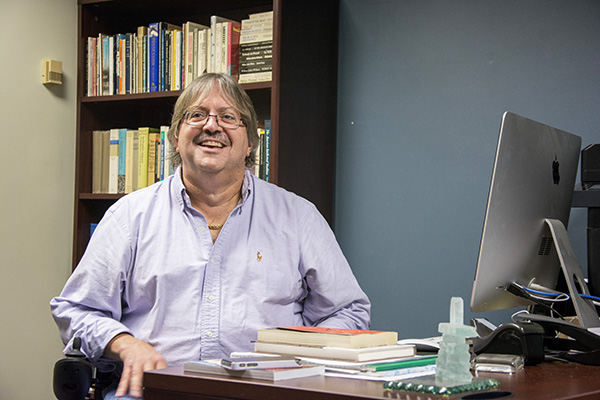
GW English Professor David T. Mitchell GW English is already well known for work in Disability Studies, an interdisciplinary field of inquiry examining the meanings of disability in culture and history, interrogating ideas of normality, and continually imagining what a more accessible world might look like. We were thus very excited to search this year…
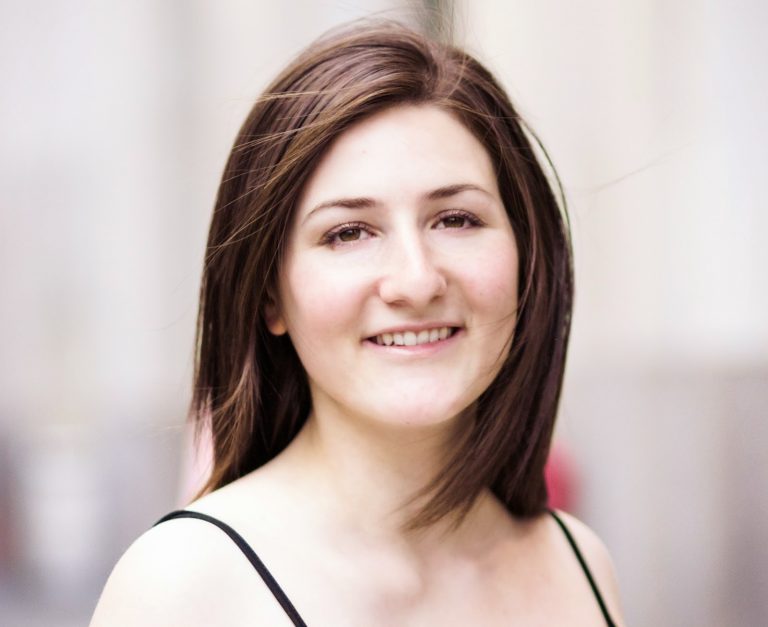
Amanda Panitch GW English BA ’11 “My Honor’s Thesis Played a Fundamental Role in the Development of My Writing” – GW English Grad Amanda Panitch, interviewed by Professor Margaret Soltan. MS: Let’s start this interview with a link to your website, which announces the exciting news that a young adult novel of yours, Damage Done, has just been…
GW English/Creative Writing Alum Mary Sette Mary Sette has taken her English/Creative Writing (with honors) GW degree and moved to film school at the University of Southern California. Professor Margaret Soltan recently talked to Mary about GW, USC, and her work in film. 1. Let’s start with the immediate present. Having recently graduated as an…
GW English Professor Kavita Daiya Prof. Kavita Daiya, who teaches postcolonial and South Asian American Literature and Cinema in the department recently was invited to give a talk at the State Department’s Institute for Foreign Services. She is the author of Violent Belongings: Partition,Gender and National Culture in Postcolonial India (Temple UP, 2008; Delhi: Yoda Press, 2013). …
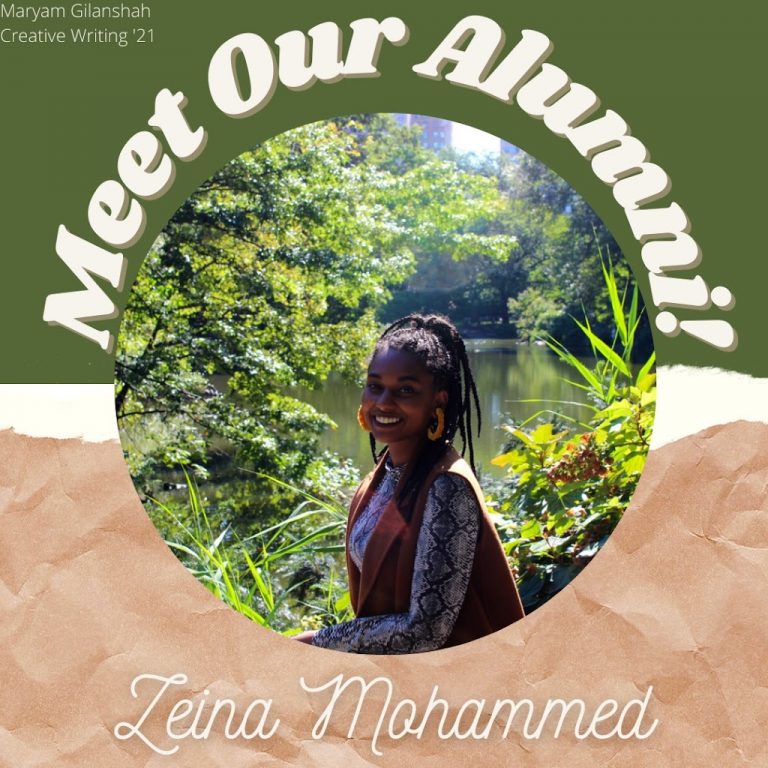
Alumna Zeina Mohammed shares insight on her experience as an English major “People Need English Majors”: Sitting Down with GW English Alumna Zeina Mohammed as told to Maryam Gilanshah, Creative Writing 2021 Why did you choose GW and Washington, D.C.? Why make that switch? Z: So my family actually lives in Washington DC….